Blog 2- Yellow Peril on the Silver Screen: Techno-Orientalism and its Effects on the Asian-American Community
In recent years, there has been an uptick in American films led by an Asian main character. From live-action films like Crazy Rich Asians and The Farewell to animated films like Disney’s Turning Red, these films all show representation of Asian culture and identity. While these films positively portray Asian people, that was not always the case. This blog post will explore the harmful stereotypes of past Asian representation in cinema with a focus on science-fiction films and their effects on the Asian community.
 |
| Still frame from Blade Runner (1982) |
The critically acclaimed film, Blade Runner, takes place in a dystopian version of Los Angeles that looks more like a futuristic version of Tokyo. When the male white protagonist is introduced, he is being served by a Japanese man at a Japanese restaurant and surrounded by billboards with Japanese models. The dominance of Japanese aesthetics in a sci-fi dystopia film is a reflection of Western society’s acknowledgment of Asia's technological advances (Lu, 2021) while also painting it as something insidious or dangerous. This appropriation of aesthetics is an example of techno-orientalism, a twist on traditional orientalism that depicts the “Orient” undergoing rapid technological advancements (Roh et al., 2015). Techno-orientalism is an expression of Western nations fearing the cultural and economic dominance that Asian countries such as China and Japan have (Roh et al., 2015). While techno-orientalism first rose to prominence through its application in cinema, it has been used to describe real-life situations such as the Covid-19 crisis as well.
This video provides a more in-depth analysis of techno-orientalism in media with visual examples: https://www.youtube.com/watch?v=l0X15iqjYn0
The prejudices that create the foundation for techno-orientalism can be traced back to the original “yellow peril” that Chinese and Japanese Americans experienced when they immigrated to America. The Noel hypothesis states that racial stratification occurs when competition, ethnocentrism, and a differential in power are all present (Healey et al., 2019). This can be applied to the situation between White Americans and Chinese Americans as they competed for jobs amidst worsening economic conditions. Prejudice against the Chinese rose and they were described as cruel, crafty, and threatening. This prejudice eventually manifested into discriminatory policies like the Chinese Exclusion Act and Anti-Coolie Act (Healey et al., 2019). These prejudiced attitudes were transferred to the Japanese as well when they immigrated to America in later years.
 |
| Protester at Los Angeles Rally spreads awareness of anti-Asian violence (Chiu, 2021) |
Techno-orientalism mirrors the same fears present in the late 1800s. As Japan and China grew as global giants and economic competitors, they threatened to dominate America in the techno-global capitalist economy (Lok & Chun, 2020). American society began to express these anxieties through racism and violence. When the Covid-19 outbreak occurred in China, American media depictions of Wuhan’s efficient surveillance tracing and contact tracing conveyed a sense of both admiration and fear of the government’s technological capabilities (Lok & Chun, 2020). These depictions help fuel the perception of the dangerous “Chinese virus,” created and hosted specifically by Chinese people to wreak havoc on those around them. Racializing the Covid-19 virus acts upon America’s historical sinophobia and opens up avenues for hate. In fact, more than 9,000 hate crimes were reported between March 2020 and June 2021 when the Covid-19 crisis was at its height of media coverage (NPR, 2021).
For more information on Asian hate crimes due to the Covid-19 pandemic, watch Covid-19: Hate crimes against Asians on the rise in the US. https://www.youtube.com/watch?v=9siwWlAuNGE
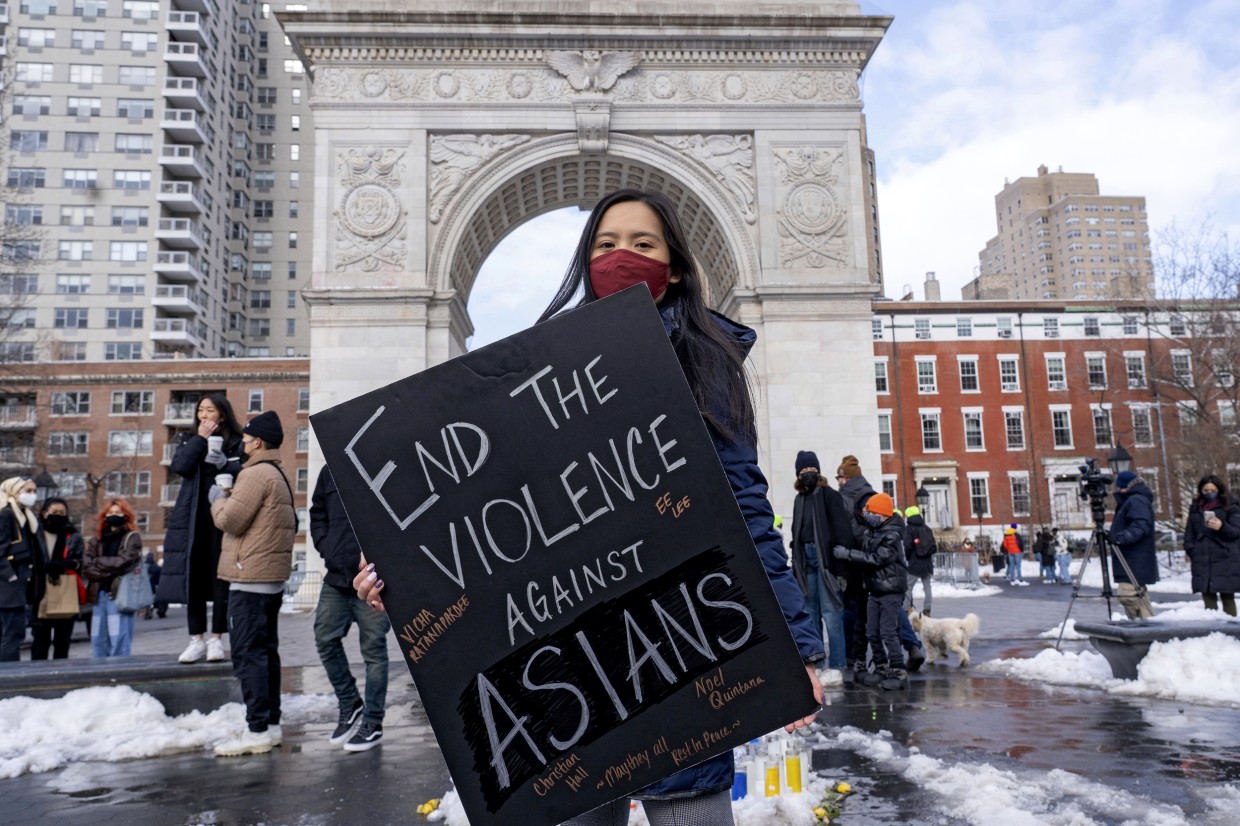 |
| Protester at End The Violence Towards Asians rally in New York (Adar, 2021) |
While techno-orientalism is often criticized for its fear-mongering of Asian technological advancement, there is another subset of people affected by it — Asian women. This is visible in sci-fi films such as the 2012 film Cloud Atlas, which cast East-Asian women to portray clones called “fabricants” who are inferior to “pure-bloods,” those who are naturally born. In Alex Garland’s 2014 film, Ex Machina, an android character named Kyoko is introduced as a live-in maid and implied personal sex attendant. She is depicted as both beautiful, obedient, and silent (Lu, 2021).
Patricia Hill Collin’s intersectionality theory can be used to explain the harm that comes from these portrayals of Asian women in American cinema. Intersectionality theory states that to study inequality, one must acknowledge the overlapping of multiple group memberships that affects an individual’s experiences (Healey et al., 2019). In this case, the overlapping identities that must be taken into account are the Asian woman’s identity as both an Asian and a woman. In the 1880s, Chinese people were seen as “racially inferior, docile, and subservient” (Healey et al., 2019). As mentioned previously, these perceptions were applied to the Japanese as well. Coupled with the identity of being a woman, who are expected to be subservient to men under the patriarchy (Healey et al., 2019), Asian women fall into a unique identity of being sexually stereotyped as exotic innocents who exist to serve (Lay, 1999). The portrayals of fabricants in Cloud Atlas and Kyoko in Ex Machina reinforce the over-sexualization of Asian women while also stripping them of their individuality as people by portraying them as androids or robots. In doing so, these characters are put into the voyeuristic gaze and create an image of Asian women being akin to prey (Hai & Dong, 2019).
For further context, watch this clip from Cloud Atlas of a fabricant's daily schedule: https://www.youtube.com/watch?v=nvUpUU6owVc
 |
| Still frame from Cloud Atlas (2012) of the fabricants |
These sexual stereotypes contribute to the dangers that Asian women face in real life. Sex tourism was common among U.S troops during World War II, the Korean War, and the Vietnam War as Asian women were brought in to sexually serve the U.S. troops (Dastagir, 2019). More recently, in 2021, a man walked into a massage parlor in Atlanta and killed eight people, six of which were of Asian descent. This man claimed to have a sex addiction and targeted the massage parlor because it was a sexually tempting place (Constantino, 2021). This stereotyping of Asian women as sexual objects put them at risk of gender-based violence that can cost them their lives.
For more information on the gender violence that Asian women face, check out Asian Pacific Institute on Gender-Based Violence's statistics on trafficking: https://www.api-gbv.org/about-gbv/types-of-gbv/trafficking/
The prejudice that the Asian-American community experiences extend far past what audiences see on the big screen, but analyzing the media that American society consumes can help paint a picture of what beliefs and attitudes are held towards the Asian community. In these unprecedented times where Asian hate crimes are at a high and the Covid-19 virus is still running rampant, it is important to stay aware of the dangers of xenophobia and protect the Asian-American community.
References
Constantino, A. K. (2021, July 7). Atlanta spa shooter who targeted Asian women pleads guilty to four of eight murders. CNBC. https://www.cnbc.com/2021/07/27/atlanta-spa-shooter-who-targeted-asian-women-pleads-guilty-to-four-counts-of-murder.html
Dastagir, A. E. (2019, March 1). From harmful fetishes to sex trafficking, Robert Kraft case highlights risks facing Asian women. USA Today. https://www.usatoday.com/story/news/investigations/2019/03/01/robert-kraft-sex-trafficking-sexual-stereotypes-asian-women-fetish-chinese-korean-prostitution/3016047002/
Garland, A. (Director). (2014.) Ex-Machina [Film]. Universal Pictures.
Hai, Y. & Dong, H. (2019.) Asian American woman cinematic image: The exotic beauty and/or perpetual foreigner. China Media Research, (15)1, 85-92.
Healey, J.F., Stepnick, A. & O'Brien, E. (2019). Race, ethnicity, gender and class: The sociology of group conflict and change. Sage Publications, Inc.
Lay, E.M. (1999). Asian American Representations. Woman and Language, (22)2, 48. https://link.gale.com/apps/doc/A59877434/LitRC?u=csuf_main&sid=bookmark-LitRC&xid=0f46dcd5
Lu, M. (2021). Gendering the techno-orient: The Asian woman in speculative fiction. [Honors Thesis, Vanderbilt University]. Vanderbilt University Institutional Repository.
NPR. (2021, August 12). More than 9,000 Anti-Asian incidents have been reported since the pandemic began. https://www.npr.org/2021/08/12/1027236499/anti-asian-hate-crimes-assaults-pandemic-incidents-aapi
Roh, D. S., Huang, B., & Niu, G. A. (Eds.). (2015). Techno-orientalism: Imagining Asia in speculative fiction, history, and media. Rutgers University Press. http://www.jstor.org/stable/j.ctt1647cqh
Scott, R. (Director). (1982). Blade Runner [Film]. Warner Bros.
Siu, L. & Chun, C. (2020). Yellow peril and techno-orientalism in the time of Covid-19: Racialized contagion, scientific espionage, and techno-economic warfare. Journal of Asian American Studies, (23)3, 421-440. http://dx.doi.org/10.1353/jaas.2020.0033
Wachowski, L., Wachowski, L., & Tykwer, T. (Directors). (2012). Cloud Atlas [Film]. Warner Bros. Pictures.

.jpg)
Comments
Post a Comment