Blog 1 - Genderism and Stereotyping: The Dangers of Transphobic Prejudice
In recent years, the LGBT+ community has made significant progress in terms of greater public acceptance into society and better media representation. Same-sex marriage was legalized in the United States in 2015 and a 2020 Pew Research Center study shows that as of 2019, 72% of Americans believe that homosexuality should be accepted. (Poushter & Kent, 2020). However, even as the LGBT+ community moves forward, there is still one letter of the acronym that is getting left behind.
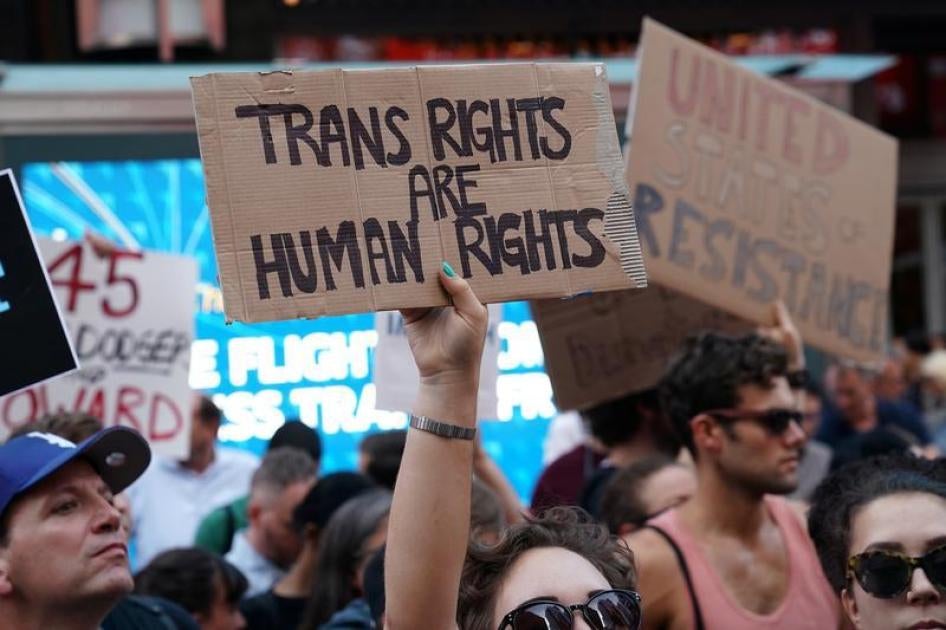 |
Protester in New York demonstrating against Trump's ban on transgender individuals in the military (Reuters, 2017) |
A 2022 Pew Research Center study surveyed Americans on societal acceptance of transgender individuals and found that while 38% of respondents saw transgender acceptance positively, 32% saw it as a bad thing with the remaining 29% responding neutrally (Brown, 2022). These results become more significant when considering that 3 in 5 transgender people report facing discrimination and more than fifty percent face difficulties acquiring medical services (Center for American Progress, 2020). These numbers were taken from the Center for American Progress’ survey on LGBT+ experiences in 2020, emphasizing how transgender individuals were significantly more impacted compared to their LGB community members. Transgender issues have appeared in the media as well, such as Texas governor Greg Abbot likening gender-reaffirming surgery to child abuse (Torchinsky, 2022).
This blog post will explore the negative stereotypes and perceptions society holds toward transgender individuals and how these prejudices increase danger towards them, with a focus on transgender youth.
American society’s understanding of gender is quite binary. In Butler’s Gender Trouble, she states that the categories of men and women are socially constructed, that gender is “performatively produced and compelled by the regulatory practices of gender coherence” (Butler, 1990, p. 24). Gender theory helps to explain the reasoning behind the prejudice that transgender individuals face. Society expects one’s performed gender to conform with one’s assigned sex and regulates this through gender policing. Transgender individuals break this gender rule, and as a resort face harsh policing that can come in the form of violence (Wade & Ferree, 2019). The Human Rights Campaign has called this violence against transgender and gender non-conforming individuals an epidemic and even discovered that 66% of these fatal violence cases against trans individuals were against Black trans women (HRC, n.d.). The consequences of extreme gender policing put transgender lives in danger and show the intersectionality of such violence as many of these victims were Black women.
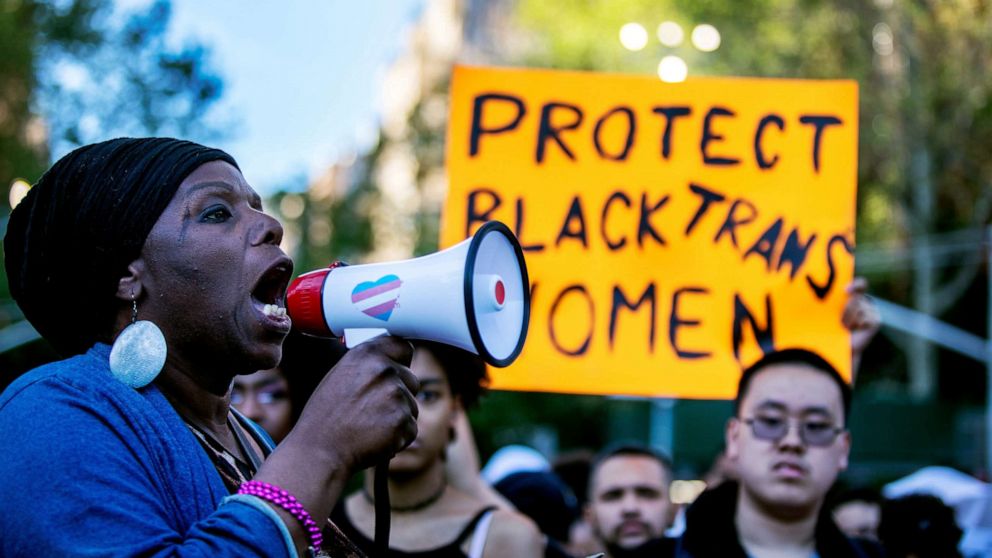 |
| Activist at New York Rally protesting the recent killings of three transgender women (Freeman, 2019) |
The sociology behind prejudice is to mobilize emotional energy in order to justify assigning a minority status to a group (Healey et al., 2019). In regards to the prejudice against transgender individuals, their gender non-conformity is used as a justification for the violence enacted on them. The cultural belief of genderism, an ideology that reinforces gender conformity, is a source of social oppression against transgender individuals and is highly correlated with gender-bashing and transphobia (Hill and Willoughby, 2005).
The consequences of transphobia can be seen in our legislation. For example, Obama-era policies requiring that public schools allow transgender students to use the restroom that matched their gender identity were rescinded by the Trump administration in 2020 (CBS, 2017). By rescinding the policy, the responsibility of interpreting whether sex discrimination law applies to gender identity lies with the state instead. While this action did not explicitly repeal legal protections for transgender students, leaving interpretation of gender identity up to the state makes students more susceptible to transphobic interpretations and attitudes from their school. When speaking in defense of the repeal, Texas Attorney General Ken Paxton says that school policy must focus on their students’ safety, privacy, and dignity (CBS, 2017). Paxton’s particular word usage leaves a sour taste in the mouth as it implies that transgender students using their appropriate bathroom is somehow a safety or privacy risk to their cisgender peers. This defense also fails to take into account the safety and dignity of transgender students, as forcing them to only use gender-neutral bathrooms can be invalidating of their gender identity as well as isolating. As a result, the justifications for this policy repeal perpetuate the stereotype that transgender individuals pose a danger or a threat to cisgender individuals.
This youtube video, Transgender bathroom bills technically force men into women's bathrooms. How ironic. touches on the controversy surrounding transgender bathroom policies. https://www.youtube.com/watch?v=JS70gSukBa4
Transgender identity has been linked to sexual orientation despite not being sexual in nature and anything surrounding topics of being transgender has been viewed as “adult” in nature (Morgan & Taylor, 2018). The pushback against allowing transgender students to use the appropriate bathroom is an example of this. The culmination of transphobia and the “save the children” mentality increases the prejudice that transgender youth face. In order to protect children’s “innocence,” parents try to keep transgender issues away from school settings (Morgan & Taylor, 2018). Aside from the school bathroom laws, a more recent issue is Texas’ stance against trans children getting gender-reaffirming care, such as puberty blockers, hormone treatments, and in some cases, genital surgery. Attorney General Ken Paxton labeled gender-reaffirming care as child abuse under Texas Law and explained that they must protect their youth from being taken advantage of (Paxton, 2022). The new directive resulted in child-abuse investigations by the Department of Family Health and Services and even caused a Houston hospital to restrict care for transgender youth amid new fears (Goodman, 2022). While under the guise of “protecting the children” this directive will only cause more harm. 45% of transgender youth have reported contemplating suicide with half of them stating the reason was linked to their gender identity (SPRC, 2008). And while there is risk in gender-reaffirming care, these procedures can improve a child’s mental health and act as suicide prevention (Goodman, 2022).
To learn more, the film Growing up Trans, details the experiences that transgender kids go through as they undergo gender-reaffirming care. https://www.pbs.org/wgbh/frontline/film/growing-up-trans
Transgender youth grow up to become transgender adults, if they even get the chance to grow up at all. Prejudice and stereotypes against transgender individuals put their mental and physical health at risk. Much of transphobia stems from a lack of understanding about such individuals. Hill and Willoughby (2005) stated in their study that people’s negative reactions to gender non-conformity are because they do not know a gender non-conforming person themselves and therefore do not see their existence or issues as important. This can be improved upon through better educational resources and better media representation of transgender individuals. Out of the members of the LGBT+ community, transgender individuals are the ones that face the most danger disproportionately. Being cognizant of the prejudice inflicted on them by genderism allows us to bring attention to unjust laws and protect the transgender community.
More statistics on transgender youth can be found at this link here. https://www.thetrevorproject.org/research-briefs/data-on-transgender-youth/
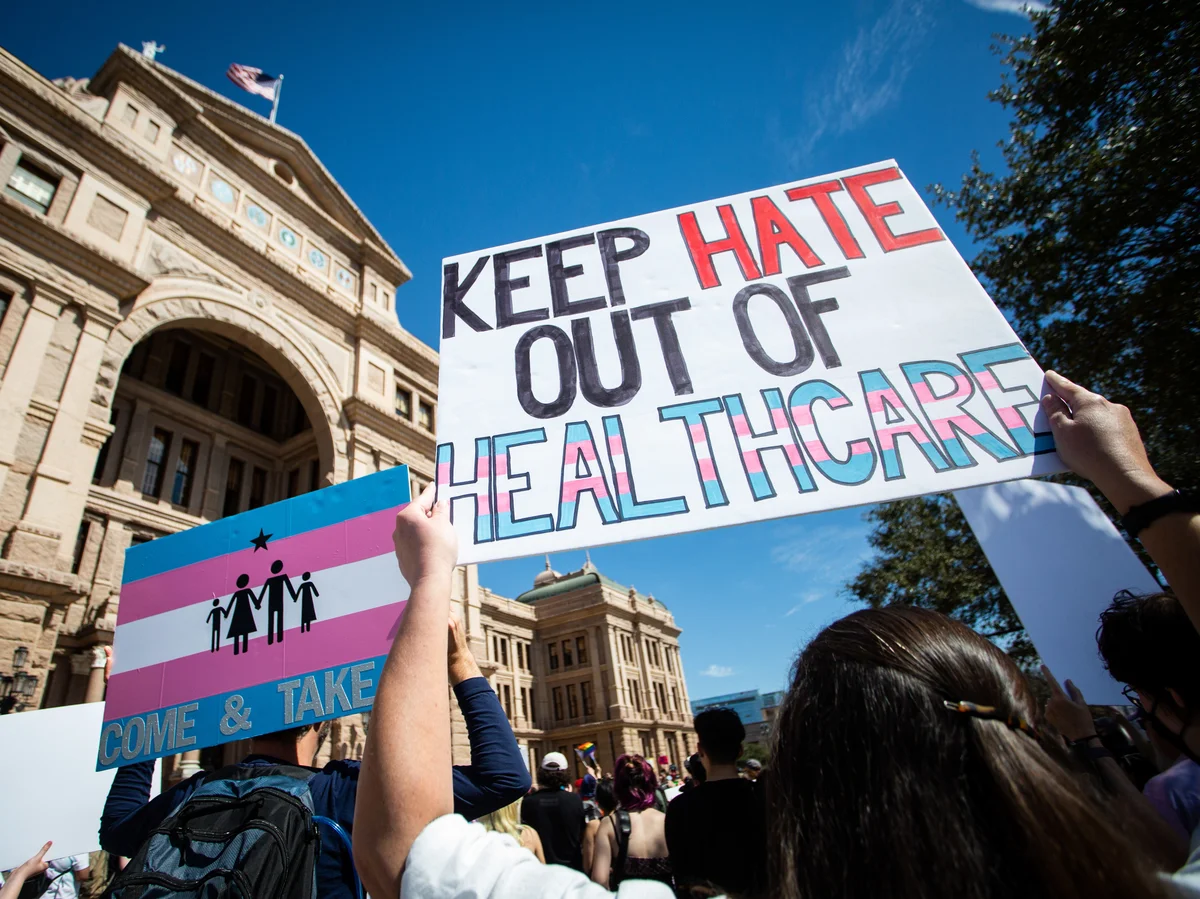 |
| Protesters at Rally for Trans Youth in Texas (Perez, 2022) |
References
Brown, A. (2022, February 11). Deep partisan divide on whether greater acceptance of transgender people is good for society. Pew Research Center. https://www.pewresearch.org/fact-tank/2022/02/11/deep-partisan-divide-on-whether-greater-acceptance-of-transgender-people-is-good-for-society/
Butler, J. (1990). Gender trouble: Feminism and the subversion of identity. Routledge.
CBS News. (2017, February 22.) Transgender bathrooms: Trump administration reverses Obama policies. https://www.cbsnews.com/news/trump-transgender-bathroom-obama-policies/?ftag=CNM-00-10aab4i&_amp=1*amg6ln*s_vid*Q01DaF9MMmlieXY3WHJpNEJ4MUlqaWFZTTllTllxaFI4MG5MM3I3QUZLRzF5WWVkQjd1T3JZU0hYZHdpR2VqYQ.
Center for American Progress. (2020, October 16). The state of the LGBTQ community in 2020. https://www.americanprogress.org/article/state-lgbtq-community-2020/
Goodman, J.D. (2022, March 11). How medical care for transgender youth became ‘child abuse’ in Texas. New York Times. https://www.nytimes.com/2022/03/11/us/texas-transgender-youth-medical-care-abuse.html
Healey, J.F.,Stepnick, A. & O'Brien, E.(2019). Race, ethnicity, gender and class: The socioligy of group conflict and change. Sage Publications, Inc.
Hill, D. B. & Willoughby, B. L. B. (2005). The development and validation of the genderism and transphobia scale. Sex Roles, 53, 531-554. DOI: 10.1007/s11199-005-7140-x
Human Rights Campaign. (n.d.) Fatal violence against the transgender and gender non-conforming community in 2021. https://www.hrc.org/resources/fatal-violence-against-the-transgender-and-gender-non-conforming-community-in-2021
Morgan, E & Taylor, Y. (2018). Dangerous education: The occupational hazards of teaching transgender.Sociology, 53(1), 19-35. https://doi.org/10.1177/0038038517746052
Paxton, K. (2022, February 21). AG Paxton declares so-called sex-change procedures on children and prescription of puberty blockers to be “child abuse” under Texas law. Texas Attorney General. https://www.texasattorneygeneral.gov/news/releases/ag-paxton-declares-so-called-sex-change-procedures-children-and-prescription-puberty-blockers-be
Poushter, J. & Kent, N. (2020, June 25). The global divide on homosexuality persists. Pew Research Center. https://www.pewresearch.org/global/2020/06/25/global-divide-on-homosexuality-persists/
Suicide Prevention Resource Center. (2008). Suicide risk and prevention for lesbian, gay, bisexual, and transgender youth. Education Development Center, Inc. https://www.sprc.org/sites/default/files/migrate/library/SPRC_LGBT_Youth.pdf
Torchinsky, R. (2022, February 25). In Texas, an unrelenting assault on trans rights is taking a mental toll. NPR. https://www.npr.org/2022/02/25/1082975946/anti-trans-bills-texas
Wade, L. & Ferree, M.M. (2019). Gender: Ideas, interactions, institutions. W.W Norton & Company.

.jpg)
Comments
Post a Comment